


『Culligan Water Softener Flow Meter Replacement: Step-by-Step Valve Maintenance』Related information(clamp on meter|electromagnetic meter|venturi meterrotameter|orifice meter|ultrasonic flow meter|mass flow meter|coriolis mass flow meter|coriolis flow meter|magnetic flow meter|magmeter flow meter|magflow flow meter|mag meter flow meter|electromagnetic flow meter|vortex flow meter|turbine flow meter|thermal mass flow meter|thermal flow meter|rotameter flow meter)
Culligan Water Softener Flow Meter Replacement: Step-by-Step Valve Maintenance
Quick Answer: Replace the Culligan softener flow meter when the display is blank, the totalizer stops, or the brine draw flow becomes unstable. Isolate the bypass valve first and release pressure before you pull the old meter. For most commercial skids, a DN15 to DN25 electromagnetic flow meter from Silver Instruments is a direct upgrade with no moving parts.
This guide covers replacement for Culligan commercial and light industrial water softeners. The same steps apply to many badge engineered softener skids used in Southeast Asia, the Middle East, and Latin America.
Signs That the Culligan Flow Meter Has Failed
The first sign is usually a blank display or a totalizer that does not count.
Another common failure is erratic pulse output. The Culligan controller may show flow when the softener is in standby. In practice, this points to a cracked turbine wheel or a bad reed switch.
We have seen this failure pattern many times. A water treatment contractor in Manila replaced three turbine meters in one year because iron particles from the municipal water were wearing down the rotor.
Isolate the Softener Before You Touch the Meter
Put the Culligan control valve in bypass mode.
Close the inlet and outlet valves. Release the tank pressure by opening the nearest hose bib or test cock.
Remove the brine line from the injector if the flow meter sits on the brine elbow. Keep a bucket under the connection because salt water will drain.
Most engineers skip this part. They pull the meter under pressure and the O-ring blows out. Then the small leak becomes a bigger repair.
Step-by-Step Culligan Flow Meter Replacement
Step 1. Remove the meter cable from the controller board. Write down the terminal numbers before you unplug anything.
Step 2. Unscrew the old flow meter from the valve body. On many Culligan commercial units the meter housing uses a 3/4 inch NPT thread. On smaller brine line meters the connection may be 1/2 inch tubing.
Step 3. Clean the meter port. Use a plastic brush to remove salt scale and rust. Check the O-ring. Replace it if it is flat or cracked.
Step 4. Apply PTFE tape to the threads of the new meter. Hand tighten the meter first. Then turn it one quarter turn more. Do not overtighten the plastic body.
Step 5. Reconnect the cable. If you are using a third party flow meter from Silver Instruments, set the K-factor in the Culligan controller. Our meters can ship with a pulse output that matches most controllers.
Step 6. Open the bypass valve slowly. Pressurize the softener and check for leaks. Run a short regeneration cycle to confirm that the brine draw flow reading is stable.
Valve Maintenance Tips for Culligan Softener Skids
The flow meter is only one part of the brine draw system. The brine injector, the bypass valve seals, and the flow restrictor all affect the reading.
Clean the brine injector screen every 6 months. Salt sludge builds up there and reduces suction. A blocked injector can make a new flow meter read zero flow.
Check the bypass valve O-rings every two years. If the bypass valve leaks, brine can short circuit the softener and the meter data becomes useless.
Replace the flow restrictor if the brine draw is slower than the design value. In practice, a worn restrictor will still allow water to pass, but the regeneration cycle will be too weak.
Upgrade Options for Harsh Water and Critical Processes
Culligan turbine meters work for basic softening. But if the soften
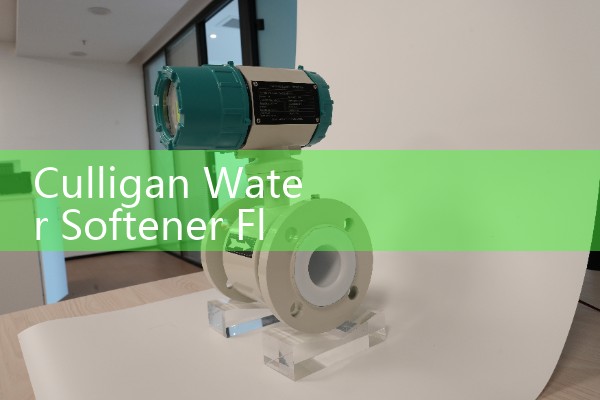
Silver Automation Instruments offers an electromagnetic flow meter for brine and soft water lines. It has no moving parts. The sensor electrodes are 316L stainless steel. The liner is PTFE. Accuracy is plus or minus 0.5 percent of the reading. Minimum conductivity is 20 µS/cm.
Common sizes are DN10, DN15, DN20, and DN25. A DN20 meter handles 0.3 to 12 m3/h. The output signal can be 4-20 mA with HART, pulse, or RS485 Modbus. Power supply is 24 VDC. The flow range is 0.1 m/s to 10 m/s. This covers a small brine draw line and a large soft water loop.
For pressure monitoring on the same skid, ask for a Silver Instruments pressure transmitter. A 0 to 10 bar unit with a 4-20 mA output, a G1/2 process connection, and a ceramic or 316L diaphragm fits most Culligan valve bodies. Send us your pressure (bar), temperature (°C), pipe size (DN), and flow range.
Field Notes from Customer Sites
Last year a pump skid builder in Dubai replaced a paddle wheel flow meter on a Culligan softener with a Silver Instruments DN20 electromagnetic flow meter. The old meter lost signal every time the brine pump started. The new meter held a stable reading because the converter ignores air bubbles and low conductivity changes.
In Jakarta, a water treatment company used a Silver Instruments DN15 flow meter on a small brine line. The client wanted a pulse output for a PLC. The meter shipped with a K-factor of 10 pulses per litre. The Culligan controller accepted the value after a short calibration.
For long cable runs over 15 m, use the 4-20 mA output instead of a pulse signal. A frequency signal can pick up noise from VFD pumps. The analog signal is cleaner.
Contact Silver Instruments for a Replacement Flow Meter
If your Culligan flow meter is dead and you want a direct or upgraded replacement, send us the pipe size, the current output signal, and the flow range.
We supply electromagnetic flow meters, oval gear flow meters, ultrasonic flow meters, vortex flow meters, thermal mass flow meters, and pressure transmitters to customers in Southeast Asia, the Middle East, Latin America, Africa, and Oceania.
Tel: +86-25-68650347
WhatsApp: +86-25-52155837
WeChat: +86 15365082610
FAQ: Culligan Flow Meter Replacement
How often should the Culligan flow meter be replaced?
Replace it when readings fail. There is no fixed interval. Many plants budget for replacement every 3 to 5 years if the feed water has high iron or hardness.
Can I use a third-party flow meter on a Culligan softener?
Yes. Match the pipe size, the output signal, and the K-factor. Silver Instruments flow meters can provide pulse and 4-20 mA outputs compatible with Culligan controllers.
What pipe size is the brine line flow meter on a typical commercial Culligan softener?
Many commercial skids use 3/8 inch to 1/2 inch tubing for brine draw. A DN10 or DN15 meter fits. Larger skids use DN20 or DN25.
Why does the new flow meter read zero after installation?
Check the bypass valve position, air trapped in the meter body, and the wiring. Also check the brine injector screen. It may be blocked with salt sludge.
Which Silver Instruments flow meter fits a Culligan softener upgrade?
The Silver Instruments electromagnetic flow meter in DN15 or DN20 with pulse and 4-20 mA output is the typical choice. You can also add a pressure transmitter for the brine line.
 Hot Product
 Related AD