

『Calculation formula for turbine flowmeter』Related information(clamp on meter|electromagnetic meter|venturi meterrotameter|orifice meter|ultrasonic flow meter|mass flow meter|coriolis mass flow meter|coriolis flow meter|magnetic flow meter|magmeter flow meter|magflow flow meter|mag meter flow meter|electromagnetic flow meter|vortex flow meter|turbine flow meter|thermal mass flow meter|thermal flow meter|rotameter flow meter)

1. What are the types of mass flow meters?
2. What are the differences between vortex flow meters and turbine flow meters?
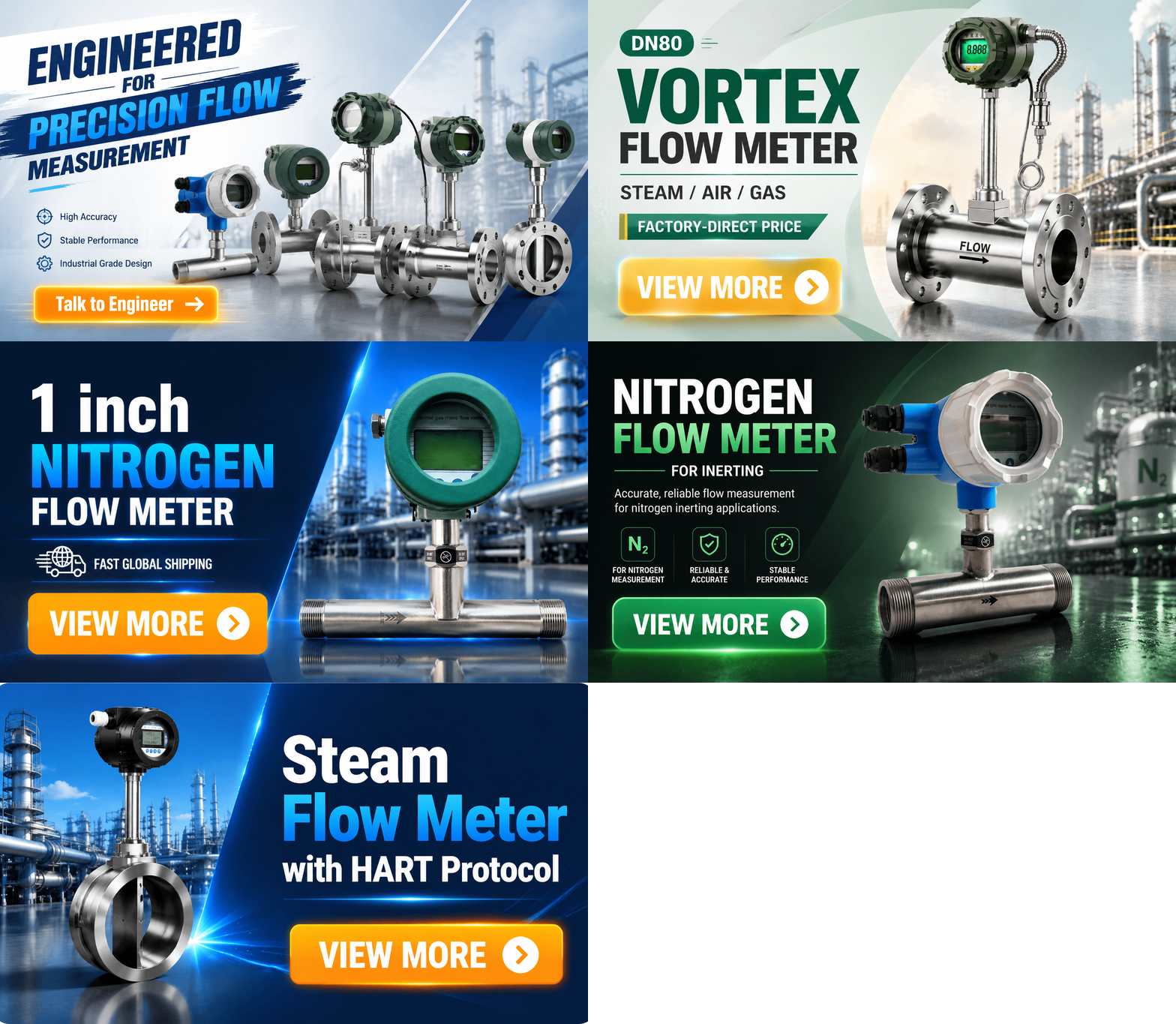
The working principle of intelligent vortex flow meters is based on the card gate vortex flow principle, which means that the vortex frequency is proportional to the flow velocity.. Its core component is an isosceles triangular cylinder located at the center of the pipeline, with its axis perpendicular to the direction of fluid flow. When fluid flows through a cylinder, vortices alternate on both sides of the cylinder, forming vortex streets. The vortex frequency is directly proportional to the flow velocity. By measuring the vortex frequency, the flow velocity can be calculated, and then the flow rate can be calculated. The flow calculation formula for a vortex flowmeter is Q=3600F · V (m3/h), where F is the flow area of the flowmeter flow body and V is the average flow velocity of the flowmeter flow body. The sensor is equipped with a detection probe inside. When the pulsating pressure generated by the vortex street acts on the probe, the piezoelectric crystal element will generate a charge signal due to stress changes. These signals are amplified, filtered, and shaped to output current or voltage pulse signals with the same vortex frequency. Each pulse represents a certain volume of fluid, and the total number of pulses represents the total volume. The turbine flowmeter utilizes the working principle of generating electric pulse signals by rotating and cutting the magnetic field of the blade when the fluid flows through the sensor. The fluid impulse causes the blades to rotate, overcoming friction and fluid resistance, and the rotational speed is proportional to the flow ve
 Hot Blog
 Related AD